
 简体中文
 Français
 لالعربية


Choosing SPC flooring for an office involves more than selecting a wood colour and wear-layer thickness. At a workstation, a chair may roll and turn repeatedly across the same small area, including the joints between planks.
For importers, fit-out contractors and project procurement teams, the question is whether the selected flooring system is suitable for that use—not simply whether the product is described as “commercial grade.”
This guide explains what to confirm before ordering SPC flooring for offices with rolling chairs, from product-specific test evidence to installation conditions and maintenance responsibilities.
Can SPC Flooring Be Used Under Rolling Office Chairs?
SPC flooring may be suitable for rolling-chair areas when the specific product, installation system and chair-protection arrangements are approved for the intended use. Do not assume that every SPC product has the same capability.
Before purchasing, obtain answers to four questions:
Does the supplier approve the exact product for the proposed office use?
Is relevant castor chair test evidence available for that construction?
What installation, castor and protective-mat conditions apply?
Does the commercial warranty cover the proposed application, and what exclusions remain?
A sample that looks attractive on a desk does not answer these questions. The procurement decision should include the supporting documents and the planned conditions on site.
1. Define the Workstation Conditions Before Comparing Products
“Office flooring” can describe a reception area, a meeting room or a workstation occupied throughout the day. These locations should not automatically receive an identical specification.
Prepare a short use schedule for the supplier. Identify the chair models where possible, the expected occupancy pattern and whether the same workstations will be used across multiple shifts.
| Project Detail | Information to Provide | Decision It Supports |
|---|---|---|
| Workstation use | Occasional, daily or multiple-shift occupancy | Review of the intended service conditions |
| Chair and castors | Chair model, wheel material, dimensions and expected loaded use | Compatibility and protection requirements |
| Floor construction | Substrate, existing finish and proposed underlay | Installation-system approval |
| Other wheeled equipment | Trolleys, mobile storage and equipment moving routes | Separate assessment of loads beyond office chairs |
| Maintenance arrangements | Cleaning responsibility, chair checks and mat policy | A workable handover plan |
For example, a buyer fitting out a 60-desk office should identify the regularly occupied desk zones separately from reception seating and meeting rooms. The total floor area alone does not describe how the floor will be used.
2. Do Not Use Wear-Layer Thickness as the Only Approval Criterion
Wear-layer thickness is one part of the flooring specification. It does not, by itself, document the behaviour of the assembled planks under repeated chair movement.
Two products with the same stated wear layer may have different core constructions, locking profiles, attached backing and installation requirements. Their supporting evidence should be reviewed separately.
When comparing quotations, record the complete construction:
Plank dimensions and total thickness.
Whether the stated thickness includes attached backing.
Wear-layer thickness and surface finish.
Core and locking-system identification.
Attached backing and any permitted separate underlay.
Relevant test-report references and intended-use approval.
Do not approve a substitution simply because its colour, total thickness and price match the original offer. Ask the supplier to confirm whether the supporting documents also cover the substituted construction.
3. Ask for Relevant Castor Chair Test Evidence
ISO 4918 describes methods for assessing flooring under the movement of a castor chair, including effects such as joint opening, layer separation and cracking in resilient or laminate flooring. Buyers may also encounter the spelling “caster” in laboratory documents.
The standard reference identifies a test method. It does not, on its own, establish that a particular SPC product is approved for every office application. Review the actual report and the acceptance criteria required for your project.
When requesting evidence, ask for:
The laboratory name, report number and test date.
The product reference and a description of the tested construction.
The test-standard edition and applicable amendments.
The specimen assembly, including backing or underlay where documented.
The test conditions, duration or cycle count, and recorded results.
The basis of any pass/fail statement.
Capital Testing’s castor chair testing overview describes reporting visual changes, separated-joint widths and raised areas. This illustrates why the review should extend beyond surface appearance alone.
If a report covers a product family rather than the exact item quoted, request a written explanation of why it applies to your order. Avoid converting a laboratory cycle count into an unsupported promise of a specific number of service years.
4. Match the Installation System to the Approved Product
Product selection and installation planning should be reviewed together. Ask the installer to confirm that the proposed substrate, preparation work and underlay comply with the selected product’s instructions.
Do not assume that a rigid plank removes the need to assess the subfloor. Obtain the manufacturer’s requirements for flatness, substrate condition, moisture assessment and any necessary preparation.
For an office refurbishment, also identify changes in level, existing flooring joints, doorway details and transitions before ordering the material.
Our SPC flooring subfloor requirements guide provides a starting point for coordinating these checks with the installer.
Where the product already includes an attached pad, do not add a second cushioning layer unless it is expressly permitted. Record the exact approved arrangement rather than relying on a general instruction to make the floor “more comfortable.”
For further procurement questions, see our guide to attached backing and separate underlay for SPC flooring.
5. Confirm Castor and Chair-Mat Requirements
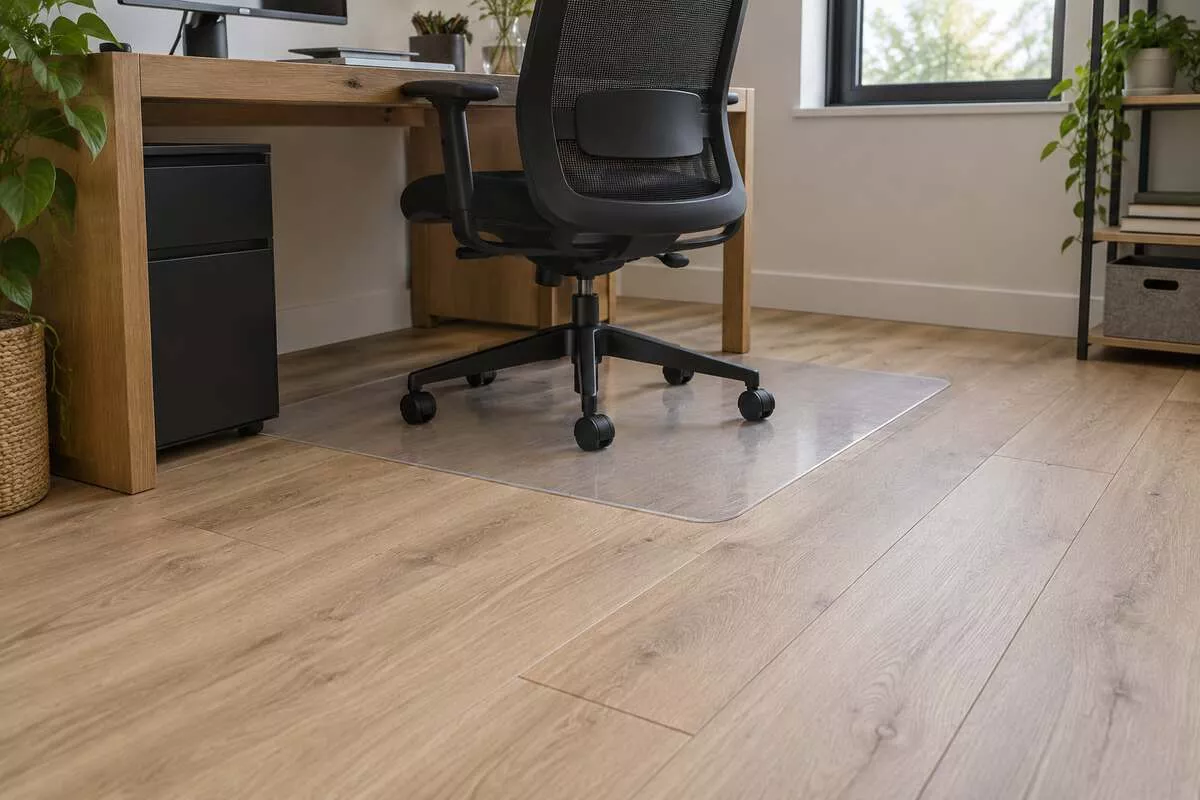
Coordinate the chair specification with the flooring supplier before furniture is purchased. Ask which wheel materials and dimensions are acceptable for the selected floor and whether protective mats are required.
A chair advertised as suitable for hard floors should still be checked against the flooring manufacturer’s instructions. Avoid choosing a universal wheel specification without considering the actual product and application.
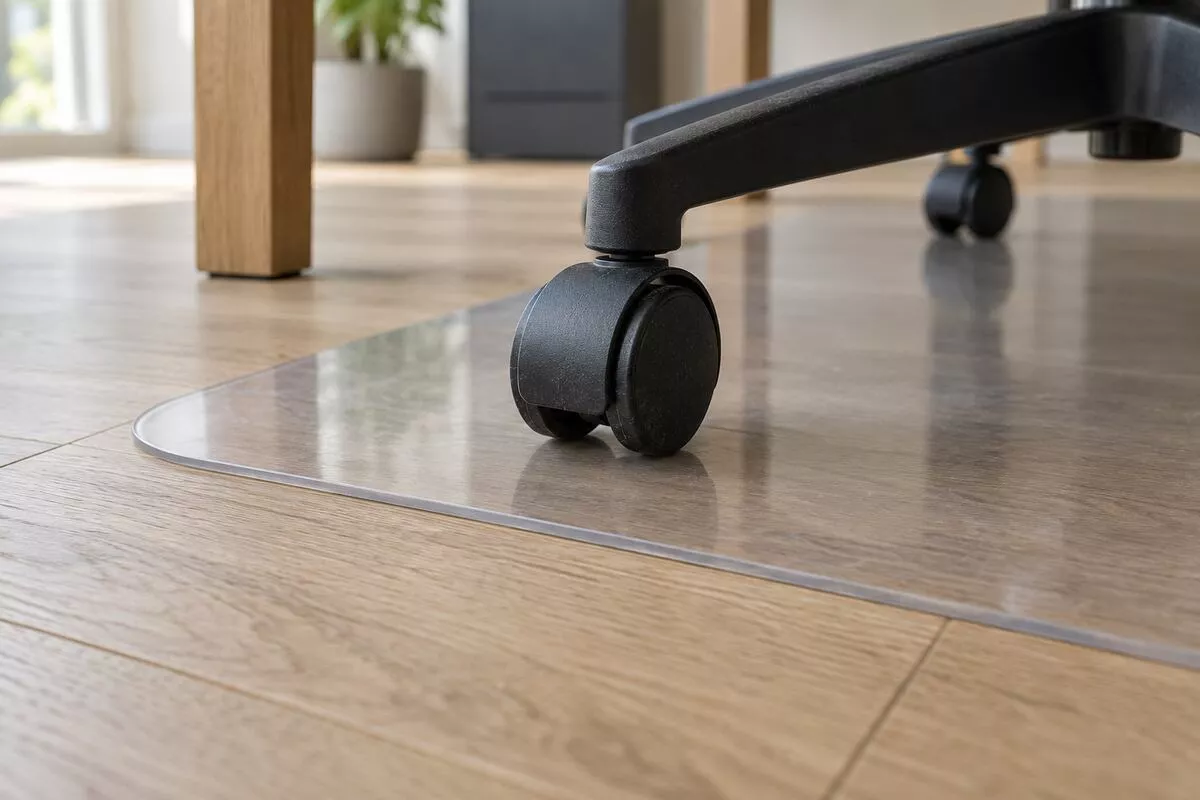
If chair mats are required, confirm:
That the mat is intended for use on the selected flooring.
That its underside and materials are compatible with the floor finish.
That it covers the chair’s normal movement area.
That its edges and placement do not create an avoidable obstruction.
Who will clean beneath it and check its condition.
Include required mats and castor changes in the project budget. They should be part of the agreed system rather than an unexpected cost after installation.
6. Review Commercial Warranty Conditions Before the Order
A warranty period does not provide a complete description of coverage. Ask for the written commercial warranty that applies to the specific product, market and proposed use.
Confirm how it addresses rolling chairs, other rolling loads, surface damage, installation conditions and maintenance. Identify any required protective measures and retain them with the project specification.
A useful written request is:
Please confirm whether the quoted SPC flooring construction is suitable for the attached office workstation schedule, including the proposed chairs, substrate and underlay. Please identify the supporting test documents, required protective measures and applicable commercial warranty conditions.
If the supplier cannot confirm the application, resolve the gap before approving the bulk order. The next step may be further evidence, a revised protection plan or another flooring system assessed for the intended use.
An office-chair test should not be treated as approval for loaded pallet trucks, heavy equipment or every type of trolley. List those uses separately.
7. Prepare a Practical Office Handover Checklist
The facilities team should receive enough information to maintain the approved arrangement after occupancy. This is particularly important when chairs are replaced or workstations are rearranged.
Record the installed flooring product and specification.
Keep the installation instructions, maintenance guide and warranty.
Document approved castors and any required mats.
Assign responsibility for removing debris and checking wheel condition.
Record the procedure for reporting visible joint movement or damage.
Keep identified spare material for future maintenance.
Where a trial installation is arranged, use it to review appearance, installation details and furniture arrangements. A short site trial is not a substitute for laboratory evidence or long-term performance approval.
For replacement planning, read our guide to spare SPC flooring and reorder quantities.
Frequently Asked Questions
Is a 0.5 mm wear layer enough for rolling office chairs?
That figure alone is not enough to approve the application. Review the complete product construction, relevant test evidence, installation requirements and any mandatory chair protection.
Does thicker SPC flooring automatically perform better under chairs?
Overall thickness alone does not establish suitability. Compare the actual products and their documented intended uses rather than assuming that an increase in thickness provides approval.
What test should buyers ask about?
Ask whether relevant castor chair testing, such as testing to ISO 4918, is available for the selected construction. Have the applicable edition, test conditions and acceptance criteria checked against the project requirements.
Are chair mats always required?
Requirements vary by flooring product and application. Obtain written instructions from the supplier and include any required mat in the furniture and flooring plan.
Can an office-chair test report cover heavy wheeled equipment?
Do not assume so. Provide the equipment details and operating conditions for a separate assessment. Different wheeled uses should not be grouped under one general approval.
What should a distributor keep on file?
Keep the quoted product specification, relevant reports, written application confirmation, installation and care instructions, and warranty terms. Make sure the supplied product corresponds to those documents.
Discuss Your Office Flooring Requirements
Planning an office renovation or a bulk flooring order? Send Floren Floor your floor area, preferred specification, destination and project schedule. Include the intended workstation use, chair details and proposed installation arrangement so these requirements can be addressed during product selection and quotation.
